Where Clockwork is located: Our Minneapolis headquarters and remote-first team
Clockwork is a remote-first B2B technology consultancy headquartered in Minneapolis, MN. Learn how our 45-person distributed team operates and collaborates.
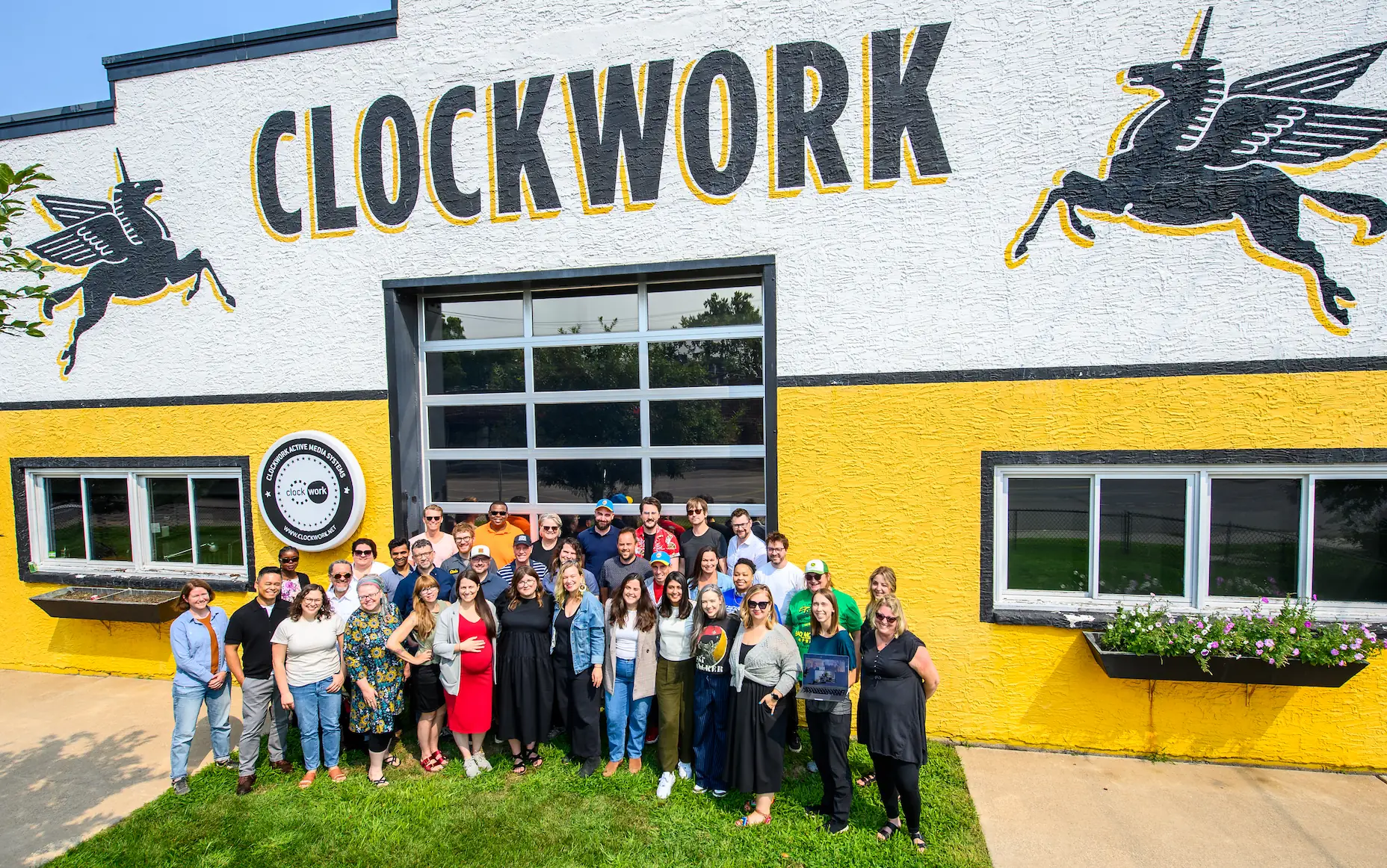
Clockwork operates as a remote-first digital technology consultancy headquartered at 1501 East Hennepin Ave in Minneapolis, Minnesota. While our physical studio serves as a central hub for collaborative design, leadership planning, and client workshops, our 45+ person team of strategists, engineers, and designers works distributively across the United States. This operating structure allows mid-market B2B manufacturers and industrial enterprises across the Upper Midwest and nationwide to work directly with senior product teams without geographic constraints. Through this model, we deliver custom software engineering, experience design, and data initiatives backed by more than 25 years of operational history.
The Minneapolis headquarters: our physical home base
Physical space still matters for a modern digital consultancy, even one that functions seamlessly across time zones. Clockwork maintains its headquarters in Northeast Minneapolis at 1501 East Hennepin Avenue, an area rooted in the city's industrial and creative history. For clients visiting our team or seeking direct contact, you can verify our location details through our Contact Us page.
The Minneapolis studio serves three distinct functions for our business:
- It provides a dedicated physical setting for intensive, full-day discovery sessions and service blueprinting workshops with client executive teams.
- It acts as an operational anchor for our leadership team, company summits, and cross-discipline working sprints.
- It grounds our civic involvement, serving as the local birthplace for regional community initiatives across the Twin Cities.
Rather than maintaining rows of empty desks or forcing arbitrary badge-swipe requirements, our office is built around flexible collaboration areas. We use whiteboards, open workshop spaces, and hybrid-equipped rooms designed for mixed remote and in-person sessions. Minneapolis clients often drop by for working sessions on product roadmaps or architecture reviews, while out-of-state clients frequently fly in for multi-day kickoffs before returning to their home offices.
Having a permanent address in Minneapolis gives our partners stability. Consultancies that operate purely as virtual networks often struggle with cohesion, turnover, and accountability. Keeping an established physical headquarters anchors our legal, security, and administrative operations under one roof, while giving our remote staff a home base they can use whenever project demands call for in-person work.
How our remote-first model operates in practice
Clockwork shifted to a remote-first operational model to expand our engineering and design capabilities beyond regional borders. Today, our 45+ team members live and work across multiple states, bringing together specialized domain knowledge in custom enterprise applications, cloud architecture, and industrial systems.
Remote-first is distinct from ad-hoc remote work. In an ad-hoc model, remote workers are second-class participants trying to listen in on conversations happening in a physical hallway. In our model, every operational workflow is documented, transparent, and built for distributed execution. Whether a developer sits ten minutes from our Hennepin Avenue studio or three time zones away, they access identical tools, code repositories, security policies, and team discussions.
Operating this way requires deliberate operational structure across several operational dimensions:
| Operational Dimension | Traditional Co-Located Model | Clockwork Remote-First Model |
|---|---|---|
| Talent sourcing | Limited to commuting radius of a single metro area | Distributed national hiring focused on deep technical domain experience |
| Work documentation | Relies on informal hallway chats and unrecorded whiteboards | Centralized digital documentation, shared specs, and recorded architecture reviews |
| Working hours | Rigid 8-to-5 regional schedules | Core collaborative overlap hours with autonomous deep-work blocks |
| Data security | Physical office perimeters and local server closets | Centralized cloud infrastructure backed by SOC 2 compliance standards |
| Client communication | Infrequent, heavy on-site status presentations | Frequent asynchronous updates paired with focused sprint reviews |
This balance protects projects from the classic agency trap: losing momentum because two team members could not find an open conference room. Our product managers and software engineers work in continuous, short feedback loops. Code commits happen daily, interface prototypes are shared in browser-based design environments for rapid review, and clients have direct access to the actual practitioners building their systems rather than layers of account handlers.
Because our team works under a unified methodology, we avoid the handoff problems common to consultancies that outsource engineering to offshore third parties. Design, development, and change enablement operate together on the same schedules, sharing direct responsibility for product adoption and software performance.
Client collaboration: local workshops vs. distributed execution
Choosing between in-person collaboration and remote delivery is not an all-or-nothing proposition. The most effective digital projects match the collaboration medium to the specific problem being addressed. We structure client engagements so that strategic alignment happens face-to-face when necessary, while development, testing, and system integration move forward in a focused, remote cadence.
For many industrial clients, working with a partner who understands the balance between local presence and distributed velocity is critical. You can read more about how this dynamic plays out when selecting a technology partner in our guide on boutique agencies versus large system integrators for industrial software.
In-person strategy and service blueprinting
Complex projects carry high organizational risk before any software is written. When a manufacturer needs to untangle a tangled quoting system, modernize a legacy portal, or rethink their customer experience, having key decision-makers in the same physical room produces faster clarity than weeks of fragmented video calls.
During early project phases, we frequently host client leadership at our Minneapolis headquarters for intensive discovery workshops. In these sessions, we run service blueprinting exercises, mapping out operational workflows across sales, customer support, warehousing, and IT. Drawing out these dependencies on physical walls helps stakeholders see where data breaks down between departments.
These sessions also happen at client facilities. Our strategists and user researchers routinely visit manufacturing plants, distribution hubs, and client headquarters across Minnesota, Wisconsin, Illinois, and Iowa. Walking a shop floor or observing how customer service reps manage order entries reveals workflow friction that rarely shows up in an emailed requirements document. You can learn more about how we structure user research in our overview of experience design in B2B.
Managing remote software engineering and AI deployment
Once the core problem is defined and the user experience is validated, distributed execution takes over. Software engineering, database modeling, and artificial intelligence implementations do not require shared office air; they require deep concentration, clear specifications, and continuous integration pipelines.
Our distributed engineering teams manage custom builds using modern containerized development setups, automated testing suites, and strict peer code reviews. Clients participate in regular sprint reviews where functioning software is demonstrated directly inside staging environments. Instead of reviewing theoretical slide decks, stakeholders test working features, test data integrations, and provide immediate feedback.
This distributed technical approach is particularly valuable for data and machine learning initiatives. Preparing a company for predictive analytics or internal automation requires auditing existing databases, establishing secure APIs, and testing models against real operational records. For a closer look at our methodology for evaluating organizational data readiness, review our breakdown of what happens during an AI strategy engagement for manufacturers.
Throughout development, our security posture remains absolute. Because Clockwork maintains SOC 2 Type II compliance, all client data and intellectual property are handled under verified security protocols, regardless of where individual engineers are typing. Client data is never used to train public machine learning models, and access permissions are strictly segregated.
The Minnesota tech diversity pledge
Our Minneapolis presence is tied directly to our civic commitment to the regional technology community. Clockwork founded the MN Tech Diversity pledge, an initiative that commits Minnesota technology companies to building more inclusive, representative, and equitable workplaces.
We started the pledge because the Twin Cities technology sector has historically faced significant gaps in racial and gender representation. While Minneapolis has grown into an influential hub for enterprise retail, healthcare technology, and industrial manufacturing, the teams designing and engineering these systems have often failed to reflect the diverse population of the state.
Through this pledge, participating organizations make public commitments to:
- Measure and publish internal workplace demographic data to establish honest baselines.
- Audit hiring, promotion, and retention practices to identify and remove systemic barriers.
- Partner with regional educational programs, coding academies, and non-profit organizations to create career pathways for underrepresented technologists.
- Share operational lessons, resources, and policy playbooks openly with peer technology firms across Minnesota.
Building inclusive teams is directly tied to the quality of technology we build. Software designed by homogeneous teams inevitably suffers from blind spots, whether in user accessibility, edge-case handling, or customer experience assumptions. Our civic efforts through the MN Tech Diversity pledge reflect our foundational belief that technology must work for all people, not just a privileged subset. To read more about our ongoing community work and company values, visit Our Impact page.

Partnering with Clockwork
Where a technology consultancy lives matters less than how they work, but having roots in an established manufacturing and corporate center creates real discipline. Clockwork brings together the grounded work ethic of the Upper Midwest with a flexible, distributed delivery model that supports clients across North America.
We work primarily with mid-market B2B organizations, industrial manufacturers, and enterprise leaders who need to modernize internal applications, connect legacy ERP databases, and build digital tools their employees and customers will actually adopt. Whether you join us at our 1501 East Hennepin Avenue studio for a strategic service blueprinting workshop or collaborate directly with our engineers through our remote product workflows, you work with seasoned specialists committed to direct answers, clear timelines, and measurable outcomes.
To start a conversation about your technical roadmap, custom software requirements, or data readiness initiatives, contact our team through Clockwork's website.