What happens during an AI strategy engagement for manufacturers
A step-by-step look at how Clockwork evaluates, plans, and pilots AI solutions for mid-market manufacturing companies without disrupting daily operations.

Clockwork helps mid-market manufacturers cut through software hype by evaluating operational problems before writing code or buying licenses. The core question plant managers and industrial executives face is how to evaluate artificial intelligence without stalling the shop floor or wasting capital on theoretical models. The answer lies in a disciplined, four-phase engagement: an AI readiness diagnostic, an executive foundations workshop, an adoption roadmap, and a contained solution pilot. Grounded in work for industrial leaders like Wilson Tool, this approach tests data quality and operator workflows first, making machine learning practical for manufacturing facilities in 2026.
Manufacturing leaders face constant pressure to adopt artificial intelligence, yet hiring a consultancy to figure out how often feels like paying for a black box of buzzwords. Enterprise software vendors promise autonomous production lines and predictive supply chains, while field managers struggle to keep daily shift notes synchronized across shifts. The disconnect between executive boardroom expectations and shop-floor reality costs mid-market industrial firms months of stalled momentum.
Treating artificial intelligence as a software rollout fails because plant operations run on physical constraints, uneven data streams, and rigid production schedules. A successful engagement does not begin by selecting a machine learning model. It begins by examining the friction points in your plant, the health of your operational records, and the willingness of supervisors to trust automated outputs.
Before the engagement starts: what you need to prepare
Before an AI strategy team from a consultancy like Clockwork arrives, companies often assume they need massive data warehouses or an internal team of data scientists. That assumption stalls projects before they even start. You do not need pristine, cataloged data to start an AI strategy engagement; you need clarity on your operational friction points.
Gathering the right raw materials ahead of time keeps the focus on measurable production goals rather than speculative technology. A mid-market manufacturer prepares best by collecting:
- Unfiltered exports from existing ERP and MES databases covering recent inventory, scrap rates, or work orders.
- Standard operating procedures and paper logs for two or three departments experiencing frequent delays.
- A cross-functional leadership contact list spanning plant operations, finance, IT, and sales.
- Documentation of previous digital initiatives that failed or met internal resistance from line workers.
| Preparation area | What consultancies actually need | What you can skip |
|---|---|---|
| Operational data | Raw extracts from ERP, MES, or maintenance logs | Expensive third-party data cleaning services |
| Documentation | Real shift handoff notes, spreadsheets, paper SOPs | Polished executive presentations |
| Stakeholder team | Plant managers, shift leads, and IT directors | An in-house machine learning engineering team |
| Problem selection | Two to three persistent bottlenecks affecting margin | A company-wide list of 50 hypothetical AI ideas |
Bringing your messiest operational realities to the table produces the fastest clarity. When teams attempt to sanitize their workflow documentation, consultants spend weeks diagnosing an idealized plant that does not exist. Honest documentation lets the consulting team see where production delays happen and where manual workarounds bypass company systems.
Reviewing past attempts at operational upgrades gives the consulting team a clear baseline. If line leads abandoned a previous barcode-scanning system because the handheld terminals lagged during high-heat cycles, that tells the team more about real-world software constraints than any IT policy document could.
Phase 1: The AI readiness diagnostic
The first formal step of a Clockwork AI engagement is the AI Readiness Diagnostic. This phase examines whether an organization possesses the technical foundation, governance habits, and cultural tolerance necessary to support automated decision-making. Consultants work directly with your technology and operations teams to inspect systems in use rather than relying on vendor brochures.
Evaluating data infrastructure
Consultants begin by examining the pipelines connecting machine sensors, line controllers, and enterprise databases. In many mid-market plants, operational technology operates on isolated local networks while business logic lives in an on-premises ERP. The diagnostic checks whether data flows with low enough latency and high enough reliability to train or feed an inference model.
The diagnostic also reviews data hygiene. Models trained on incomplete maintenance tickets or inconsistent material scrap codes will output faulty predictions. Clockwork audits the completeness, timeliness, and accessibility of historical data records, identifying blind spots where human data entry introduces errors. If your team wants automated defect classification but only records scrap tallies on weekly paper sheets, the diagnostic calls out that gap directly.
Assessing team readiness
Technology represents only one leg of the stool. An AI readiness diagnostic spends equal energy examining how comfortable plant supervisors and departmental leads are with algorithmic assistance. If operators do not trust automated schedules, they revert to dry-erase boards and personal notebooks within forty-eight hours of a deployment.
Clockwork conducts targeted interviews across the organizational chart, from shop-floor supervisors to the VP of Operations. These conversations reveal where teams fear replacement, where they distrust existing software, and what manual tasks consume their working hours. Pinpointing these human factors early keeps the eventual implementation focused on augmenting worker output rather than imposing unwanted oversight.
Phase 2: The AI foundations workshop
Following the diagnostic, Clockwork convenes key stakeholders for an AI Foundations Workshop. This collaborative session cuts through industry misconceptions and levels the knowledge playing field for everyone in the room. Plant managers, quality control directors, and executive leadership sit together to establish a common vocabulary around artificial intelligence, machine learning, and automation.
The workshop uses real examples of industrial applications to demonstrate what AI handles well and where it fails. Clockwork details the differences between deterministic automation, computer vision for quality inspection, and natural language interfaces for equipment maintenance documentation. Grounding the conversation in tangible shop-floor scenarios prevents executives from chasing science projects that offer no return on investment.
These structured working sessions draw on methods proven across other digital modernizations. When digital product consultancy Clockwork helped Clearfield modernize a paper-based process, they relied on collaborative scoping workshops and design sprints to map user needs before proposing software changes. The same principle applies to AI strategy: bringing disparate departments together to map physical production steps prevents expensive engineering missteps.
By the end of the workshop, participants stop viewing artificial intelligence as an abstract magic wand. Instead, they treat it as an operational tool with specific input requirements, error rates, and maintenance demands. The team leaves with an agreed-upon set of criteria for evaluating potential use cases, including expected margin impact, data availability, and shop-floor adoption risk.
Phase 3: Building the AI strategy and roadmap
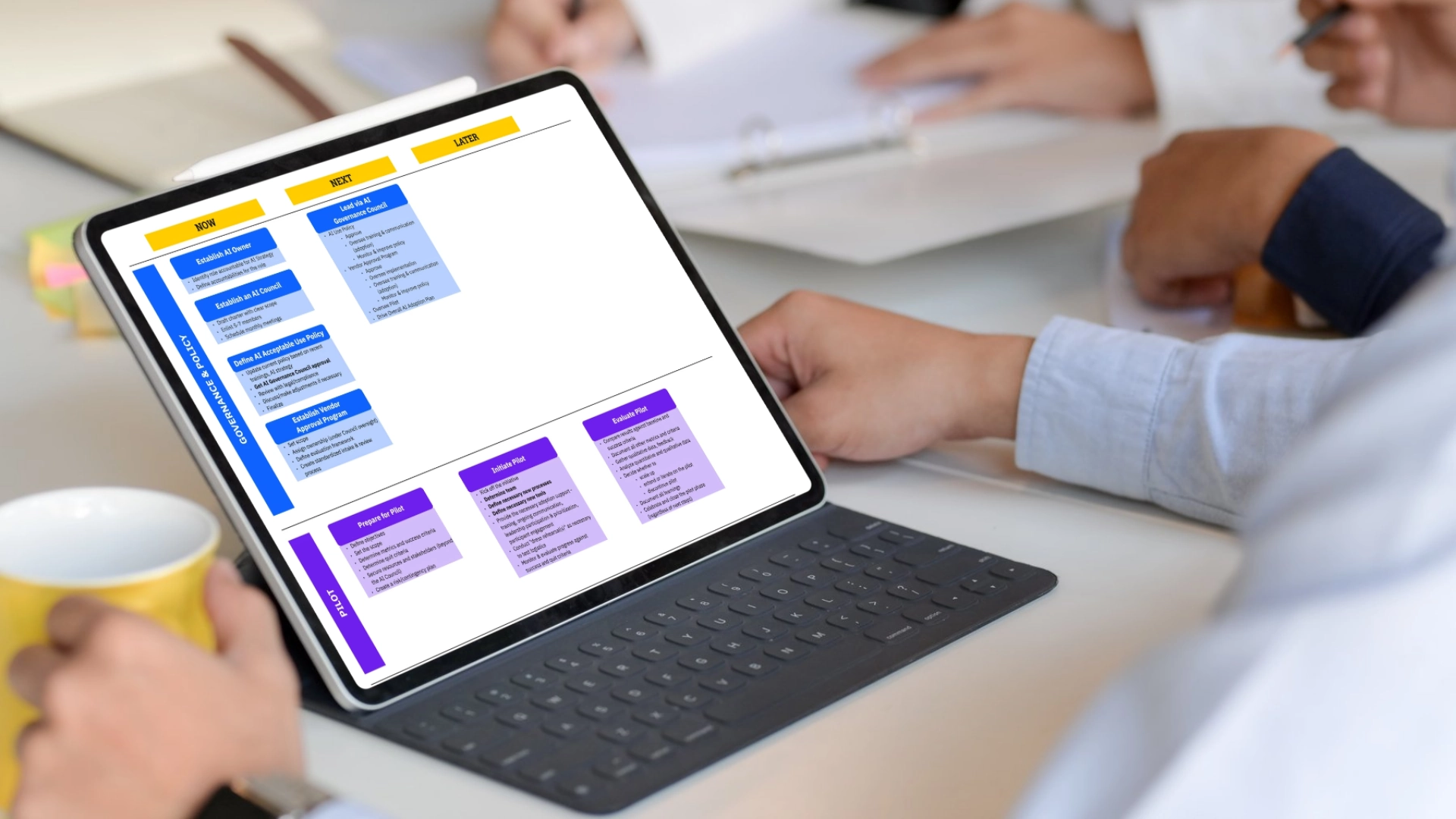
With shared understanding established, Clockwork translates diagnostic findings and workshop discoveries into an AI Strategy and Roadmap. This deliverable prioritizes prospective initiatives based on technical feasibility and business impact. Rather than proposing a massive multi-year enterprise transformation, the roadmap outlines a phased sequence of manageable projects.
The roadmap reflects Clockwork's long-standing operational philosophy: "People. Process. Technology — in that order." A sophisticated neural network brings zero value if plant operators find the interface hostile or if it requires changes to upstream workflows that suppliers cannot meet. Every initiative on the roadmap details the human change management steps and process revisions required before writing code.
Clockwork ranks use cases using a simple matrix that weeds out low-value, high-effort distractions:
- Quick operational wins that clean up existing manual reporting loops using basic automation.
- Near-term pilots that introduce predictive or classification models to high-volume production lines.
- Long-term foundational investments, such as unified plant data pipelines, required for autonomous dispatching.
- Deprioritized ideas that carry excessive regulatory risk or depend on unavailable sensor data.
Use Case Scoring Structure:
High Impact + High Data Readiness  -> Priority 1 (Pilot Candidates)
High Impact + Low Data Readiness   -> Priority 2 (Infrastructure Enablers)
Low Impact  + High Data Readiness  -> Priority 3 (Quick Automations)
Low Impact  + Low Data Readiness   -> Eliminate (Distractions)
For manufacturing organizations, cross-functional services outlined on Clockwork's services overview show how strategy connects to execution. The roadmap establishes clear gates: Phase B cannot proceed until Phase A achieves a measured improvement in process speed or scrap reduction. This structure gives CFOs and operations leaders strict governance checkpoints to protect capital allocations.
Manufacturers facing broader legacy tech hurdles often realize that roadmapping AI requires updating adjacent systems first. As explored in Clockwork's guide on how to modernize a manufacturing technology stack without stopping the line, software updates must respect the continuous rhythm of plant operations.
Phase 4: Launching the solution pilot
The final active stage of an initial strategy engagement is the AI Solution Pilot. Clockwork designs the pilot to prove a single business hypothesis within a bounded operational scope. Instead of attempting to optimize the entire facility at once, the pilot focuses on a single cell, a specific packaging line, or an isolated administrative bottleneck.

A focused pilot limits operational disruption. If a machine vision model designed to flag tool wear underperforms, production on adjacent lines continues unaffected. The engineering team establishes clear, quantitative benchmarks before deployment, such as reducing false-positive defect tags by 15 percent or cutting fifteen minutes off daily inventory reconciliations.
Speed matters during the pilot phase. Long, drawn-out proofs of concept lose stakeholder backing and sap plant morale. Clockwork applies rapid prototyping cycles to validate utility quickly. In a comparable initiative for the Minnesota Lottery, Clockwork applied artificial intelligence to transform accessibility compliance and future-proof content workflows in just three weeks. Applying this execution speed to manufacturing pilots yields fast feedback from the operators using the system daily.
During the pilot, software engineers and experience designers work closely with line workers to refine the user interface. An algorithmic recommendation is useless if an operator wearing work gloves cannot acknowledge the prompt on a ruggedized terminal. The pilot tests both computational accuracy and ergonomic reality.
After the pilot: scaling and change management
Deploying a successful pilot proves technical feasibility, but scaling that success across multiple facilities requires structured change management. This is where most industrial digital transformations stall. A tool that functions well under the watchful eye of an engineering pilot team often degrades when handed over to three shifts of regular operators.
Clockwork's strategy engagements emphasize long-term adoption alongside software delivery. As highlighted on Clockwork's about page, solving problems for humans using design and technology requires brutal honesty about organizational habits. Scaling an AI solution requires:
- Rewriting standard operating procedures to include algorithmic prompts as standard operating checks.
- Training shift supervisors to interpret model confidence scores rather than treating software outputs as unquestionable commands.
- Establishing ongoing data governance practices so drift in raw material quality or sensor calibration does not degrade model performance.
- Creating a direct feedback loop where operators report inaccurate model recommendations without fear of reprimand.
This deliberate approach mirrors Clockwork's ongoing engagement with industrial tool manufacturer Wilson Tool, where the focus centered on charting a clear path toward responsible AI adoption and innovation. By anchoring technology in measurable operational habits, manufacturers prevent custom software from turning into expensive shelfware.
When companies connect shop-floor systems with back-office databases, adoption spreads faster. Integrating predictive intelligence with enterprise systems gives sales and operations teams a single operational truth, an approach detailed in Clockwork's breakdown of how industrial manufacturers connect ERP and CRM data to close more deals.
Common questions about AI consulting timelines and costs
Industrial leaders evaluate digital engagements through a strict lens of risk, schedule, and capital return. Below are direct answers to the questions plant executives ask most frequently during initial strategy discussions.
How long does the diagnostic take?
A thorough AI readiness diagnostic for a mid-market manufacturing organization typically takes between three and six weeks, depending on the number of physical facilities and the complexity of existing data pipelines.
The process moves quickly because it does not attempt to clean your data or re-architect networks during the assessment. It focuses strictly on uncovering the current operational state, interviewing stakeholders, and identifying immediate risks. Companies that supply sample data extracts and provide access to line supervisors within the first week see results much faster.
Do we need an internal data scientist first?
No. Mid-market manufacturers rarely need full-time, in-house data scientists to benefit from artificial intelligence. Most practical industrial AI applications rely on established foundation models, computer vision frameworks, and well-understood predictive algorithms tailored to your specific process data.
Hiring specialized data scientists before defining your AI strategy often creates friction. Highly compensated researchers sit idle while the company struggles with foundational data access and basic network connectivity. Clockwork recommends defining use cases and validating pilots first, using external engineering partners, before deciding whether your operational volume justifies dedicated in-house research staff.
What if our legacy systems are paper-based?
Paper-based processes do not disqualify you from adopting AI; in fact, they often pinpoint your most profitable automation opportunities. Many manufacturers still rely on physical clipboards for shift logs, equipment checklists, and quality audits because paper is fast and reliable in industrial environments.
Before training complex predictive models, Clockwork helps manufacturers convert those physical choke points into structured digital inputs. The collaborative scoping workshops and design sprints used with clients like Clearfield show that modernizing paper workflows can occur rapidly alongside initial AI planning. Once operational data moves from clipboards into structured databases, deploying intelligent automation becomes straightforward.
Manufacturing organizations interested in learning how tailored technology and experience design drive real shop-floor outcomes can explore Clockwork's industry solutions or request an AI Readiness Diagnostic directly at www.clockwork.com.